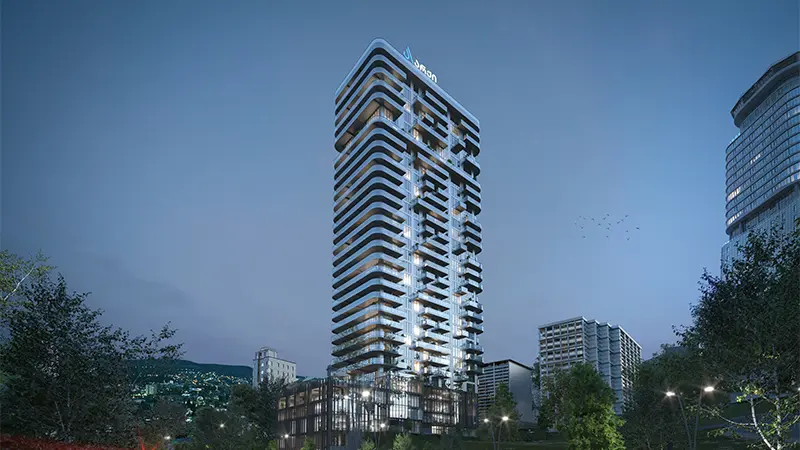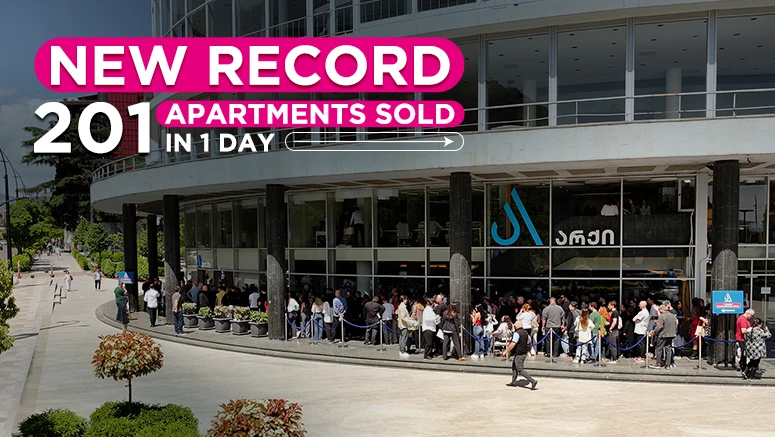
Cross-border capital tends to show up in certain places for specific reasons: risk-adjusted yield, understandable entry terms, and a relatively easy path to exit. In 2025, under construction apartments in Tbilisi increasingly matched that checklist. Especially investors from Israel and the Gulf (including the UAE), already used to competitive pricing and compressed yields at home, made a move to grab it.
In Israel, official data shows that the market is cooling. Price growth is moderating (Israel’s Central Bureau of Statistics reported annual price change of 0.5% over Aug–Sep 2025 vs the same period a year earlier). The average apartment prices are around ₪2.3m (~$750,000) and the cost of leverage remains high (Prime ~6% in Sep-2025), which compresses cash-on-cash yields unless you underwrite meaningful appreciation. In Dubai, real estate remains an intense market: Knight Frank reports AED 544.2bn in residential sales value in 2025 and 205,400 transactions, while prime values pushed above AED 4,300 psf by Q4 2025.
The data screams maturity and crowding: the market looks great now, but for investors with a long-term plan the next successful deal depends more on “cycle timing” than “pricing inefficiency.” This is especially important for investors who expect to make up for their investments by turning the new real estate into rentals: as of 2025, Deloitte cites gross rental yields around 6.7% . That’s pretty solid, but considering valuations are high and supply is rising it’s not unrealistic that those yields may start shrinking. Experienced investors are starting to look for a second markets where returns are higher and don’t rely as much on continued appreciation.
So experienced UAE and Israeli investors have been looking to diversify and Tbilisi emerged as one of the markets of interest. It does make sense because as things stand now, Georgia’s capital city offers a pretty solid “second-market” equation: high-single-digit yields (according to Galt&Taggard: 8.6% by Dec-2025) and an under-construction market where installment structures allow strategic equity deployment.
How good an opportunity is Tbilisi apartment investing for professionals?
Professional buyers with long-term plans don’t measure good investment by highest upside. They’re looking for repeatable returns that are understandable, financeable, and defensible under scrutiny.
As of 2025, the overall real estate picture in Tbilisi is pretty solid: primary prices kept rising at a normalized pace, rents stayed in a stable above-average range, and yields remained investable. In Galt & Taggart’s 2025 full-year overview, the primary market price for apartments in Tbilisi reached $1,373/sqm by Dec-25, while average primary prices rose 4.0% y/y in 2025; at the same time, the report notes an average rent of $9.8/sqm for a typical 50–60 sqm new apartment, with rental yield kept at 8.6%.
The fastest way to “sense-check” the most opportune apartments to invest in is to benchmark inventory and pricing across districts, before narrowing to specific projects and developers.
Why UAE and Israeli investors specifically invest in under-construction apartments in Tbilisi
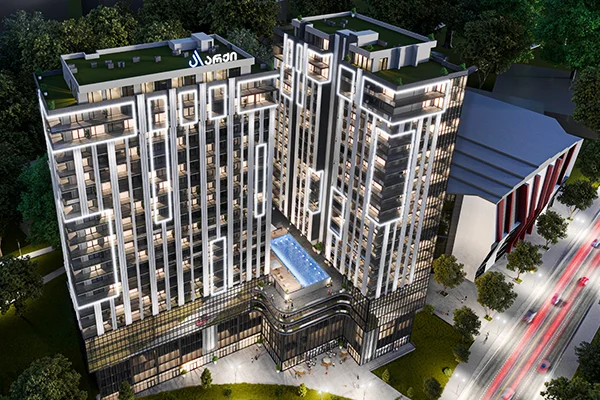
The under-construction segment works for cross-border investors when three things align: (1) a repeatable entry structure, (2) measurable liquidity, and (3) credible counterparties.
1) The deal structure adjusts well to foreign capital transactions
Under-construction transactions in Tbilisi commonly involve internal installment payment plans from the developer. That matters for foreign investors who need to optimize capital across multiple markets: staged payments can reduce idle cash and match deployment to construction progress.
Galt & Taggart’s survey notes that 94% of apartments were already sold in projects finishing in 2025. Most of those sales were being paid for through inner installment schemes offered by developers instead of a bank.
That said, in Georgia the success of internal payment plan structures heavily depends on the developer credibility. The pace of construction and payment options aligning favorably is often key for investor success, especially when the foundation of the project has barely been laid. Larger, more systematic developers like Archi tend to be more trustworthy in this regard: they offer standardized sales processes, have clearer milestone-based schedules and more options for payment plans, which is typically easier for cross-border buyers to navigate when construction is ongoing.
2) The underwriting story in 2025 became easier to defend
Markets feel “investable” when official indicators confirm what brokers say. GeoStat’s Residential Property Price Index (RPPI) for new residential property in Tbilisi reported that in Q4 2025 the index was up 3.3% y/y, and 59.4% above the 2020 average.
At a macro level, Georgia also continues to attract foreign capital: GeoStat’s preliminary table shows 2025 total FDI of $1,296.9m. While FDI is broader than residential, it supports the overall view of investment opportunities in Georgia: international investors consider this a place worth deploying capital, which is an important datapoint for real estate investors new to the market to consider when underwriting cross-border apartment exposure.
3) Supply is being carefully tracked and priced to keep yields healthy
Professionals care about the pipeline. In 2025, permitted living area in Tbilisi declined 4.2% y/y to 1.7mn sq.m, yet remained 32% above the 2015–22 “healthy level” average. Disciplined selection of developer, district and project matters more than ever when it comes to real estate investing in Capital of Georgia, but it’s clear that market is nowhere near cooling anytime soon – and the investor who’s careful about district logic, demand drivers and risk exposure can greatly benefit in the long run.
About apartment investing for professionals considering buying into the market: the 2025 numbers in context
If you’re a professional investor, you know that what matters most for long-term investment success is market behaving consistently enough to model. In 2025, three datapoints stood out.
1) Price growth remained positive (indicating market entering a “healthier” phase)
Galt & Taggart reports that in 2025, primary market price growth accelerated in 4Q25 and reached $1,373 in Dec-25, with the average primary market price up 4.0% y/y. It may be down from 11.6% in 2024 and 20.2% in 2023, but there’s a broader context to consider: since the start of the 2022 Russia-Ukraine war, Georgia (and Tbilisi, in particular) received a large influx of refugees from both these countries.
Rapid surge in population led to the rapid spike in demand for residential units (among buyers and renters), which led to market overheating for a while. If anything, 2025 shows that the demand across country has stabilized to healthy markers and is poised to grow at a sustainable pace, without abnormal fluctuation, with demand from both local and international buyers/renters remaining consistently high.
For under-construction buyers, this matters because the typical build-to-handover timeline spans years. It matters whether appreciation is explosive (and fragile) or steady (and underwritable). If anything, Georgia has shown that its explosive growth wasn’t fragile, stabilizing at a healthy, underwritable level.
2) Rents and yields stayed in “investable” territory
In the same year-end view, Galt & Taggart shows district rent levels (Dec-25) and compares rental yields across cities, with Tbilisi at 8.6%. This is the kind of return” that makes apartment investing workable even when you assume conservative price appreciation.
For comparison’s sake, this is higher than the Eurozone’s standard, which typically falls between 3% to 6%, and even Dubai’s own 6% to 8%.
3) The More Selective the Investor, the Higher Chances of Success (District, Project, Developer – Minimizing Risks, Maximizing Absorption)
The same Galt&Taggart report highlights meaningful dispersion across districts in both pricing and rents. Professional real estate investors that see success in the Georgian market, know that the key is choosing the right property for sale in Tbilisi taking factors such as district infrastructure (and prospective development), project (including the offered extra amenities), overall pricing and residential demand into account.
To minimize the risks further, many start by choosing the developer first (portfolio, delivery discipline, product standards, resale liquidity) and start optimizing for the exact micro-location based on their specific projects. Archi is one such giant among Georgian developers that has managed to become as a “low-risk, low-regret” development partner for many cross-border investors: if there’s a solid portfolio showing that a developer has consistently demonstrated planning discipline and successful execution across the years, underwriting is typically simpler.
Is it better to invest in apartments or houses? And are serviced apartments a good investment?
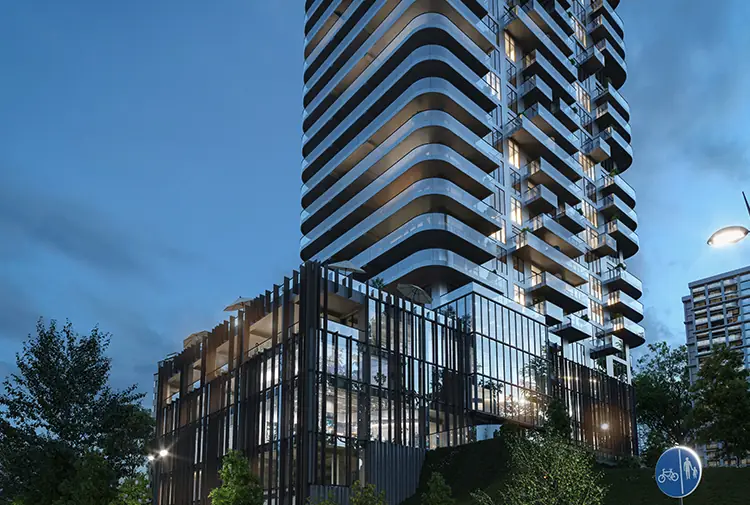
Apartments vs. houses (in Tbilisi’s context)
- Apartments usually win on liquidity: more comparable transactions, more rental demand, and easier resale benchmarking.
- Houses can outperform in specific submarkets, but they’re harder to price, harder to manage remotely, and may contain certain risks in land/title nuances.
There’s really no comparison: cross-border buyers who want scalable exposure tend to prioritize investing in apartment buildings (often even via multiple units) rather than individual houses, unless they have a solid long-term proven strategy that specifically focuses on houses or they partner with a strong local operator (which is typically a rarer occurrence for Tbilisi, at least).
Investing in serviced apartments can work – if done right
Serviced apartments can be compelling when there’s a guarantee for three conditions:
- They come with a credible operator (or management structure)
- The location has consistent demand (business travel, education, longer-stay tourism)
- The unit economics still make sense after fees
The upside is operational simplicity particularly for overseas owners. The downside is that returns depend heavily on management quality and seasonality. Treat it like an operating business attached to real estate. Sometimes the risk can be worth it, but in the end it all comes down to what the numbers tell you.
If your strategy includes premium positioning (executive rentals, brand-grade finishes, wide-centre locations), then investing in a Tbilisi luxury apartment can certainly be a better fit for long-term rental play underwriting logic.
Practical checkpoints for UAE and Israeli buyers (without the legal rabbit holes)
For more in-depth information about purchasing real estate in Georgia and documentation orientation check out our Foreigners Guide to buy Real Estate in Georgia and then tailor it with local counsel once you shortlist projects.
Other than that, here’s the “don’t miss this” list investors interested in Georgia should always keep on hand:
- The developer can make or break you. Before investing, make sure they can prove they can deliver results
When it comes to investing in projects still under construction, timing is everything. Those who step in early, get the best deals – but it may not matter in the long run. If the investor cannot back up their promises with a solid portfolio, then investing in their project is basically gambling. In Georgia, working with established, systematic developers matters. Archi is often shortlisted as a lower-risk option because the company has a trackable history and works transparently. Investors get to assess process maturity, product consistency, and project scale more easily than with small, single-project builders. - Payment schedule vs. construction milestones
Internal installment plans can be an attractive feature as they allow bypassing the bank, and, along with the classic mortgage – the classic interest that mortgage comes with. But treat them like a contract-backed financing plan: a trusted developer should be able to offer you several options to best align with your interests and prospective schedule should be transparently tied to construction progress. - Exit plan before entry
Decide upfront whether the exit is resale at handover, long-term rental, or a serviced model. The exit strategy should determine the unit size, layout, project and district you’ll invest in. Otherwise your interests and ROI may severely misalign. - Currency and income matching
Have a solid plan to manage currency exposure. Your capital may be in AED/USD-linked planning or NIS, while your operating costs and pricing signals will be local. Make sure the numbers work in your favor.
Quick FAQ (kept tight)
- Is buying an apartment a good investment? When it comes to Tbilisi, 2025 data supports the idea that buying an apartment in Tbilisi can come with significant long-term ROI when you combine normalized price growth with yields that remained in the high-single digits.
- Is it better to invest in apartments or houses? For cross-border investors, apartments are preferable in most cases because they’re easier to price, rent, manage, and resell at scale.
- Are serviced apartments a good investment? They can be. But only if you trust the operator, the fee structure is transparent and the data shows that the demand for this type of residential units in the district/area is consistently high.
Tbilisi’s under-construction market attracts international investors for a simple reason: it offers a simple structure, minimal bureaucratic red tape, and consistent yields. For UAE and Israeli buyers specifically, there are additional factors such as recognizable structures, the familiar installment-driven entry and measurably increasing foreign demand they can tap into before the market starts to truly mature and cool down (which, for fairness sake, doesn’t seem to be anytime soon). Done correctly, investing in Georgia as a whole, and Tbilisi in particular, is not about snapping up cheap real estate. It’s about tapping into a market that still rewards disciplined early-stage positioning.