Georgia’s standing has noticeably strengthened in the eyes of international buyers who want to acquire viable long-term assets – and are looking to do so through an easy and quick process that doesn’t require dealing with months’ long administrative friction. For many investors in the Gulf and Israel, for example, the appeal of investing in Georgia is not so much “cheap property” (though the average price is noticeably more favorable than Eurozone, or, indeed, their local markets) as much as repeatable deal mechanics: in Georgia, an investor can underwrite, verify title, register ownership, and operate the asset with a relatively standardized, quick and simple playbook.
This blog is a beginner-friendly guide on how to invest in real estate in Georgia with due diligence, with detailed information about registration, taxes, and operations.
Real Estate Investing Guide: How Does it Work?
Before you start looking at units, have a clear goal of what you’re buying for. In Georgia, investors typically go for one of the three following models:
- Long-term rental cashflow;
- Value growth over time
- A blended strategy (steady rent + occasional price appreciation).
When someone asks how can I invest in real estate the start should always be a simple underwriting rule: you don’t buy real estate for gross yield, you buy net yield. A real estate return on investment calculator is based, in the end, on a pretty simple checklist of inputs: annual rent minus vacancy, minus operating costs, minus management, minus taxes, divided by purchase price.
A practical note for buyers from UAE or Israel: you’ll often find that Georgia’s advantage is not that it “beats Dubai” or “beats Tel Aviv” on every metric, but that entry and ownership logistics are simpler and streamlined, so assessing price risks and viable returns can take less time and allow you to move faster in a market where timing can be key to success.
The Deal Mechanics: What to Do When Buying Real Estate in Georgia?

As the most active hub for real estate development in the country, Tbilisi can be a useful benchmark, when calculating risks and returns. Galt & Taggart’s 2025 overview demonstrates that the demand and price growth have stabilized after the 2023-2024 overheating risk, largely caused by the Russian-Ukraine war. According to the same review, the average primary-market price reached $1,373/sq.m in Dec-25, and the report notes +4.0% y/y average primary-market price growth in 2025. The secondary market (new projects) reached $1,316/sq.m (+7.9% y/y), while rents for 50–60 sq.m apartments were $9.8/sq.m in Dec-25, with rental yield referenced at 8.6%, so those investing in Tbilisi real estate can expect healthy returns on their investments.
That said, the same review is very clear that prices and demands vary greatly across the city so choosing the correct strategy and managing expectations is key. Just because an apartment unit looks nice or is in a nice district, doesn’t mean it’ll serve your purpose like you’ve imagined. First settle on one of the abovementioned three strategies, then do the research, and only buy once you have the data proving that your goals and the project align:
- Lawyer Up: Get in touch with a local real estate lawyer that has proven experience of helping foreign nationals buy real estate in Georgia.
- Choose the Correct Project: Define your strategy (long-term rent vs mixed use), target unit size, budget ceiling, and required net yield minimum before you start considering anything.
- Check the Legal Side: Have a lawyer verify the developer background, project title, encumbrances, seller authority, land status and construction documentation.
- Sign and Pay: Use a purchase agreement that clearly specifies the unit ID, delivery terms (if under construction), payment schedule, and penalties. Pay via traceable channels (avoid informal side arrangements).
- Register: File for ownership registration with the National Agency of Public Registry (NAPR). Standard registration for rights to immovable property is, as of right now 150 GEL within 4 working days, with expedited options available: 270 GEL in 1 working day or 350 GEL same day (rates and timelines may be subject to change).
- Handover: Do snagging, meter handover, and acceptance documentation before final closure.
NAPR registration and legal DD are non-negotiables, everything else (interior upgrades, furnishing, even city selection) are variables that can be optimized later.
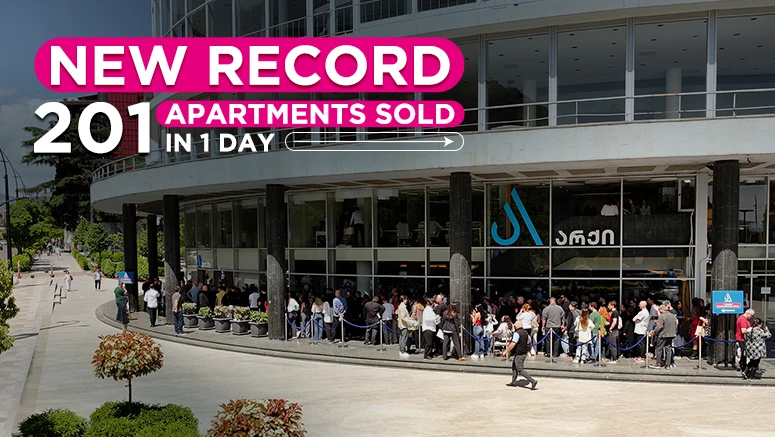
Developer reliability and experience are important in all cases, but if you’re buying across borders and may not always be able to keep up with the construction, it’s a metric that shoots up in importance tenfold: you need to reduce operational surprises. Archi, for example, has a reputation as one of the leading developers in the country and it’s well-earned: the company began in 2006, and has since successfully implemented 51 projects, and with over 1,058,723 sq.m. of completed construction.
What You Pay for Owning Real Estate in Georgia: Taxes and Recurring Ownership costs
Georgia is generally viewed as tax-efficient for residential rentals, but that doesn’t mean there are no nuances to be aware of.
1) Rental income tax: Under the Tax Code, when a natural person rents out residential space for residential purposes and makes no deductions, the income is taxed at 5%.
2) Annual property tax (ownership, except land): Property tax for individuals is linked to their income. The Tax Code ranges based on a natural person’s family income during the tax year:
- Up to GEL 100,000: 0.05% to 0.2% of market value (taxable property at year-end).
- GEL 100,000 and more: 0.8% to 1% of market value.
- There is also an exemption for a natural person’s residential property if family income does not exceed GEL 40,000, but land can still be treated separately.
3) Filing and payment deadlines: The Tax Code states that a natural person must file a property tax return no later than 1 November, and pay property tax (and property tax on land) no later than 15 November.
4) Capital gains logic: Surplus gained from selling a residential apartment (house) owned for more than two years is treated as tax-exempt income in the relevant provisions.
Underwrite a Deal Like a Professional:
When considering investing in real estate in Georgia, you need to build three scenarios:
- Base case: realistic rent, normal vacancy, standard management cost, conservative maintenance reserve.
- Downside case: higher vacancy, lower rent, one major repair, slower resale.
- Upside case: strong occupancy, better rent, minimal repairs.
And, last but not least, standardize your assumptions. This can be especially important if you’re comparing opportunities across Georgia and UAE or Israel: put vacancy as a % of gross rent, add a repair reserve, and treat furniture as capex amortized over a few years. Georgia may look “too good” in certain instances on paper, especially if your local market is cooling down or dealing with y/y yield compression. The truth is, there’s no such thing as too good – there’s just right timing and right goals aligning correctly with realistic expectations.